Brooklyn startup to send robot for ISS maintenance next year
A Brooklyn-based company is developing advanced robotics for NASA that could revolutionize space exploration and colonization efforts.
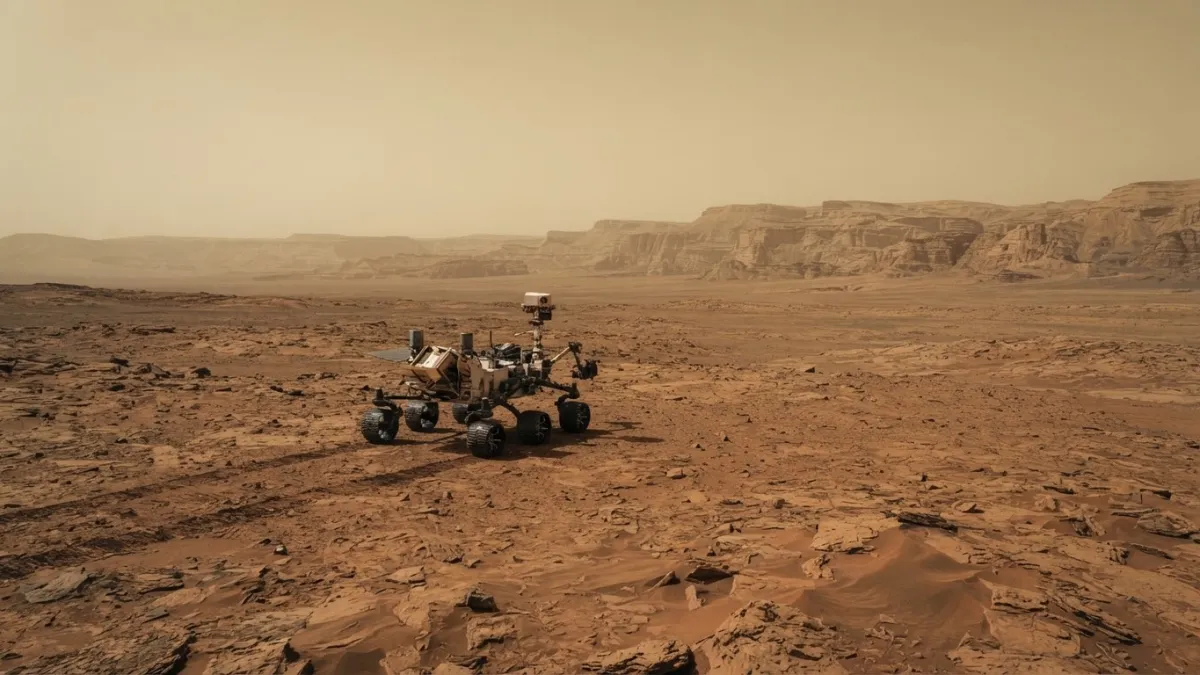
Jamie Palmer, 26, and Ethan Barajas, 23, founded Icarus Robotics in 2024, operating out of Newlab, an innovation center in the Brooklyn Navy Yard. Their company is focused on creating robots to automate manual labor and routine tasks currently performed by astronauts.
Their robot, named Joy, is slated to be delivered to NASA in early 2027. By spring, Joy will launch aboard a cargo ship traveling approximately 17,000 miles per hour to the International Space Station (ISS). There, she will spend roughly 12 months conducting maintenance and inspections.
“These guys cost millions of dollars to train, they’re Air Force and military test pilots — some of the most badass people ever — and they’re taking out trash, doing seal inspections and moving bags like they’re in an Amazon warehouse,” Barajas explained. “We’re going to automate all of this stuff.”
The ISS, launched in 1998, requires constant human maintenance, a costly endeavor. NASA estimated in 2021 that it costs $133,000 per hour to support each astronaut on the ISS.
Research conducted on the ISS, benefiting from the unique micro-gravitational environment, has led to significant advancements, including the development of cancer drugs like Keytruda. As of 2026, over three million patients worldwide have benefited from this medication.
Freeing up astronauts’ time for research is crucial. When NASA added a fourth crew member to the ISS in 2025, the number of experiments conducted doubled.
Barajas’s interest in space exploration began in his youth when he participated in NASA’s HUNCH program at the Johnson Space Center in Houston, Texas. He later interned at NASA’s Jet Propulsion Laboratory in Southern California.
Palmer, who previously worked as a testing and software engineer for Lewis Hamilton and Mercedes’ Formula 1 program, joined Icarus after relocating to the US on scholarship to study robotics at Columbia University. He has experience deploying autonomous robots in hospitals.
While NASA has previously explored robotics, Joy distinguishes herself with enhanced dexterity and the ability to learn and improve over time.
Simulating the conditions of space for testing has proven challenging. The Icarus team utilizes a specially designed table at Newlab to minimize friction and mimic microgravity. They also employ a Falcon 20 aircraft to create brief periods of weightlessness.
Joy’s journey to the ISS will be facilitated by a commercial partner, such as SpaceX. Once in orbit, she will operate for approximately six hours daily, divided among NASA, NYU, and the Naval Research Laboratory.
Initially, Joy will be remotely controlled by a human operator on Earth. The operator’s movements will be mirrored by the robot, allowing Joy to collect data and eventually operate autonomously. Future missions could involve more complex tasks like external repairs and construction.
“There’s such a long list of things that we need to do to build persistent lunar or low-Earth orbit habitats — to get humans into space,” Palmer stated. “We have big ambitions. Joy is just the start of what we’re building.”
Source
“Meet the 20-something Brooklyn whiz kids building robots NASA will send to space next year”
Read the original report ↗This story was written with AI tools from the original report credited above and published after automatic checks. No person read it before it was published. If you spot an error, please tell us: corrections are published on our corrections page. Read our editorial policy · Report an error · Corrections
Read next
Gemini 12 mission: A pivotal moment in Space exploration
Fifty-seven years ago, on November 11, 1966, the Gemini 12 mission launched, marking a significant step toward NASA’s ambitious goal of landing…
Related

Caught up in five lines
The Brief: the day’s biggest stories, written by our desk at and .